Draped Capuche | Lithuanian Designer High-Neck Warm Sweaters
-
2026-11-13
Hello,
In 1525, the Italian friar Matteo da Bascio experienced a vision.
In this vision, St. Francis appeared to him and, among other instructions, commanded him to abandon the comfortable 16th-century monastic garments and return to the simple, T-shaped robes with a hood sewn from coarse wool, as worn at the dawn of the Franciscan Order.
Matteo obeyed and immediately sewed himself a new hooded cloak in secret.
Such was the beginning of the Capuchin friars' habit, which centuries later became a source of inspiration for some of the most talented fashion designers.
From the very beginning, clothing became a significant and controversial part of the ideals of the movement that later became the Capuchin Order. Matteo and his followers had to fight for several years for the right to wear this radically simple attire.
Having become the founder of the new religious order, Matteo da Bascio established a strict dress code, one of whose essential elements – a coarse brown wool cloak with a large hood – was both a symbolic mark of poverty and a practical necessity.
Capuchin friars were required to wear this garment constantly – both outdoors and indoors – so it became such an inseparable part of their image that the very name of the order derived from the word capuche (the word "hood" / "capuchin" stems from the same Latin root cappa, meaning a head covering).
Despite the fact that even at the peak of their popularity, friars made up only a tiny fraction of society (the Capuchin Order reached its highest membership – nearly 35,000 – in the 18th century), they left a notable imprint on aesthetic evolution.
One of the reasons was that many friars belonged to the so-called mendicant (begging) orders. This meant that their daily activities required not reclusive spiritual contemplation, but social engagement, public presence, and frequent walking.
Such a lifestyle demanded appropriate clothing. The Capuchins and several other religious orders wore a detachable short hooded cape – the cappuccio.
Designed to protect the friars in all weather conditions, this accessory was sewn from sturdy, often woolen fabric. It covered not only the head, but also the shoulders and neck, leaving draped layers of fabric in the front when the hood was taken down.This detail became one of those that caught the attention of an entire generation of 20th-century designers.
Early interpretations of the draped high neck can be found as early as the 1920s in the collections of iconic French designer Madeleine Vionnet, while knitwear featuring this detail appeared slightly later.
Innovative American designer Claire McCardell left an immense mark across many areas of fashion, including this one. Her 1945 knitted hooded blouse embodies the concept of a monk's cowl in a fresh, modern form while preserving the high-neck silhouette – when the hood is lowered, the collar fabric falls softly and naturally.
Rick Owens is just one of many contemporary designers still finding ideas and inspiration in monastic garments. Yet even when garments are created without intending to reinterpret religious heritage, we can discern widespread historical connections in the softly draping folds of a sweater's collar.
In this newsletter, we have selected three warm sweaters featuring different styles of high collars.
All Lithuanian Designer Warm Sweaters
High Draped
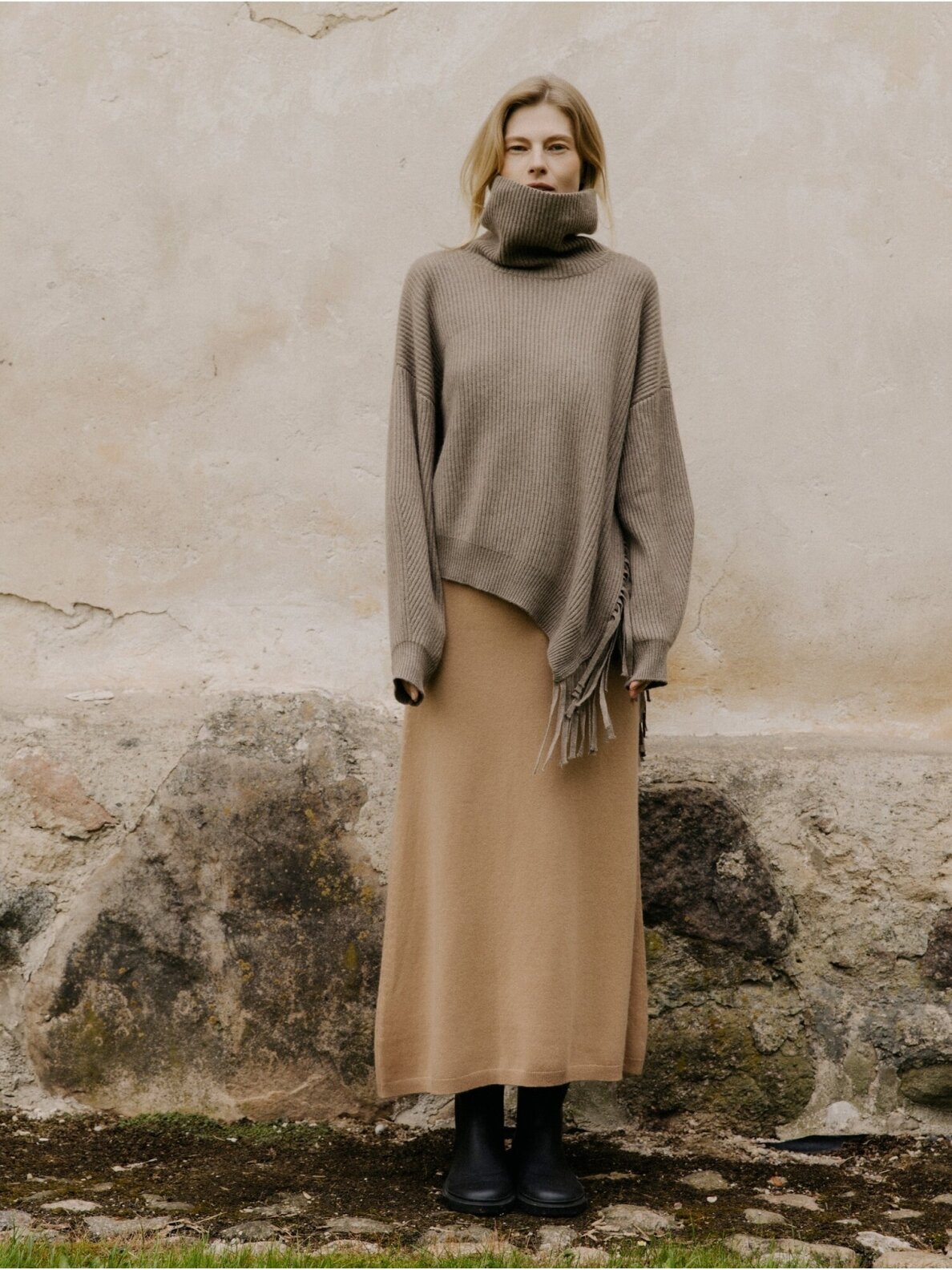
While we can trace echoes of the Capuchin habit in the softly draping structure of this high neck, there is not a trace of the ascetic discomfort that the order so devotedly sought.Every detail of this sweater is designed for comfort. Notice the shape of the neckline – the collar is set into an exceptionally spacious opening. Then let your gaze drop to the sleeves – raglan shoulders provide unrestricted freedom of movement.
What is harder to notice in a photograph is the soft fabric, composed of 70% cashmere and 30% merino wool, which allows this sweater to be worn effortlessly under a coat despite its oversized silhouette.
Enveloping Cables
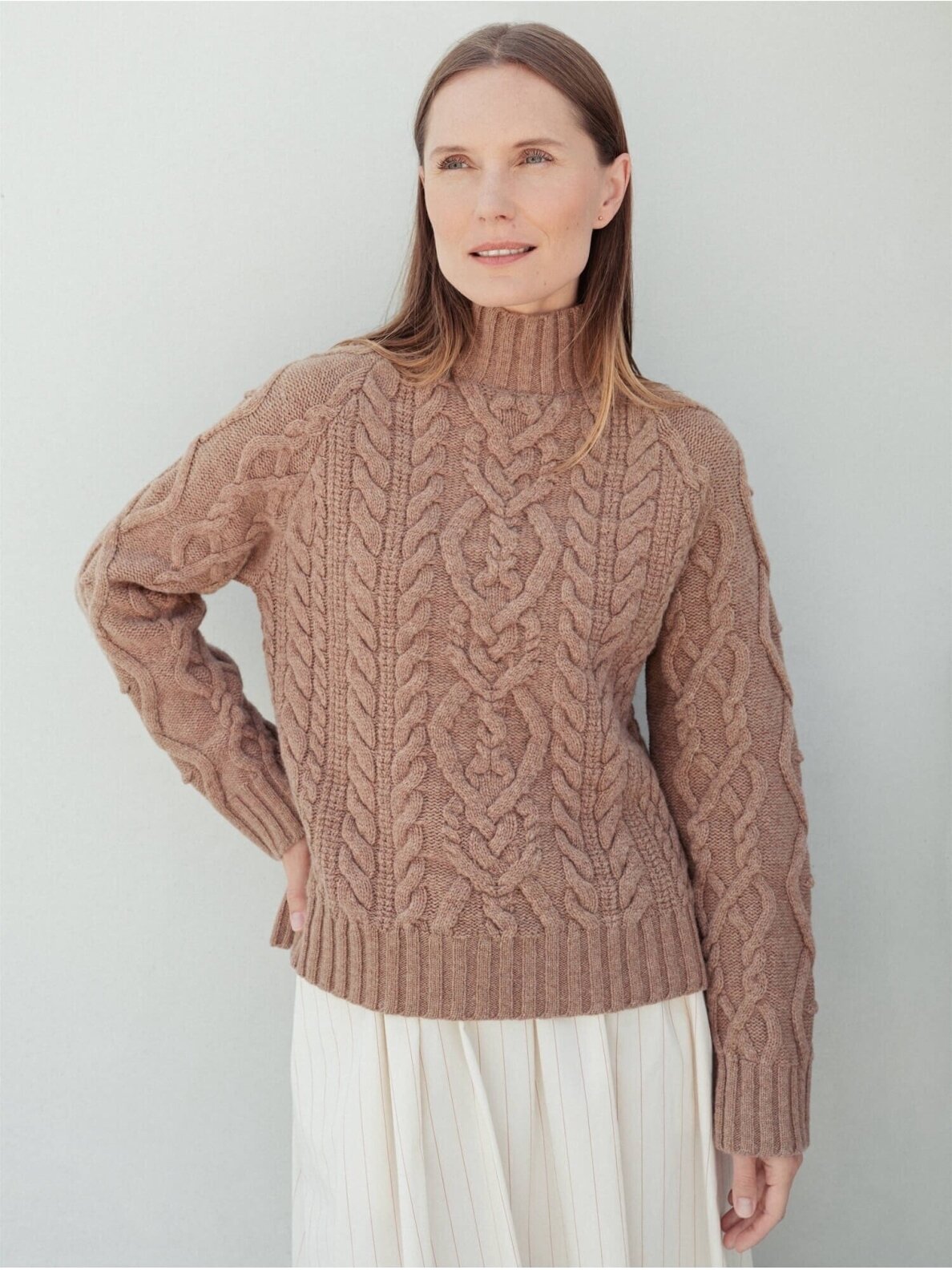
This cozy, enveloping cable-knit sweater deserves attention for its nuanced details.Crafted from a blend of 15% cashmere and 85% merino wool, the sweater is slightly widened not only in the body, but also in the sleeves. The broader silhouette is maintained all the way to the cuffs, which, although ribbed and gathered, remain spacious.
THREE IDEAS: Knitted Hats
Writer Margaret Atwood once said: "I have 12 hats, and each one represents a different personality. Why just be yourself?"
A hat that fits in the palm of your hand can hold transformative styling power. And if stylistic playfulness is not your goal, simply enjoy the pleasure of wearing natural wool hats.- Cocoa-colored baby alpaca wool hat (with a matching triangular scarf available)
- Incredibly soft 100% combed cashmere hat
- Patterned Nordic-style wool hat (with a matching scarf)
Triple Touch
While the design of this sweater follows the established rules of classic high-neck knits, its fiber composition is truly exceptional.The sweater is knitted from a three-fiber blend: 60% baby alpaca, 25% lana extrafine superwash, and 15% nylon. Each of these fibers serves its own purpose, yet the most significant is baby alpaca.
Among all grades of alpaca wool, baby alpaca is surpassed in quality only by Royal Alpaca (which accounts for less than 1% of all alpaca wool).
Due to its extraordinary softness, hypoallergenic properties, and complete absence of lanolin, baby alpaca is considered especially suited to being worn directly against the skin.
Every Friday we share stories on fashion design, culture, and the nature of materials. Subscribe to "Baltas Miškas" to receive inspiration delivered straight to your inbox on time.