Inaccessibly simple | colorful linen clothes by Lithuanian designers
-

2026-06-19
Striped linen garments appeared nearly a century later than cotton ones.
Only with the development of modern dyeing techniques did Northern Ireland, where the linen industry thrived at the beginning of the 20th century, become the first place where woven striped linen fabrics were produced.
Striped clothing was a fashion trend, but while many wore more affordable cotton versions, linen garments decorated with brightly colored, woven stripes were a true luxury.
Author Edith Wharton was particularly attentive to the significance of subtle clothing details in shaping an image, especially in environments where exceptional quality garments were a daily standard. Alongside her analytical intellect, the writer was renowned for her elegance and held the view that proper dinner attire is „an absolute sign of civilization“.
In her second novel, „The Custom of the Country“, Wharton shares these thoughts of the complex heroine Undine Spragg:
„She was dressed with a kind of scrupulous casualness... wearing a neatly striped morning shirt of the finest, thinnest foreign linen, which looked as though it had been laundered by a fairy, paired with a dark skirt. It was a style of such absolute simplicity as Undine recognized to be impossible to fake; its cheapness was an illusion that only the immense wealth of the wearer could create.“
Manufacturing shirts of such quality required not only master craftsmanship and technology, but also exceptional raw materials. According to experts, the described shirt could only have been made in a few places, most likely in Northern Ireland from exquisite flax grown in the Kortrijk region of Belgium.
Although Ireland was famous for its top-quality linen goods, they were often made using imported flax, as Irish flax itself was of average quality.
In the early 20th century, striped shirts, beyond being highly desirable, also became an expression of freedom and women's emancipation – worn by cyclists, office professionals, and other accomplished women.
It is therefore no surprise that striped linen garments captivated not only Edith Wharton, but also many artists of that era. Egon Schiele painted his wife wearing striped linen dresses, while Pablo Picasso, Amedeo Modigliani, and many others created portraits of women adorned in striped attire.
The painting above depicts the sister of another famous painter, Pierre Bonnard, wearing what is believed to be a striped linen shirt. Pierre Bonnard was a French Post-Impressionist influenced by Paul Gauguin and Japonisme, the influence of which can be seen in this work.
Notice the shirt cuffs – stripes angled at 45 degrees were traditionally used as a visual hallmark of superior craftsmanship. More on this below.
Striped linen garments remain enduringly popular and are part of a growing trend toward richer, deeper linen colors.
In this newsletter, we have curated three rich-toned 100% linen tops – a vintage jacket-style model, classic oversized shirts, and a minimalist wrap top.
All Lithuanian Designer Summer Linen Styles
Fifties Inspired
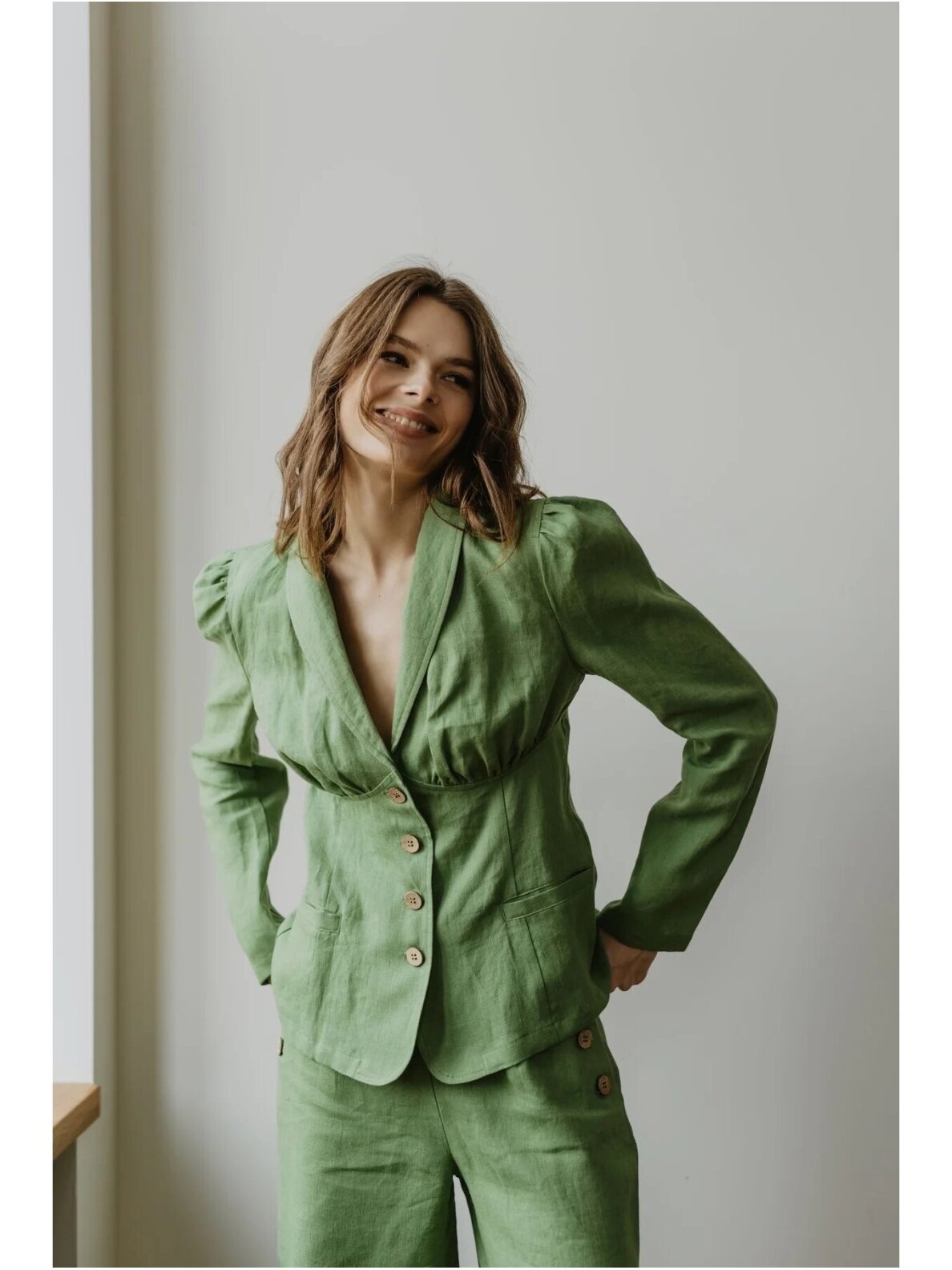
This 100% linen jacket is as charming as it is practical.Unlike many minimalist linen garments, this jacket stands out with an intentional and meticulously considered design. Its silhouette is subtly structured, giving the garment an elegant and expressive look.
Inspired by 1950s vintage style, it features a fitted waist, tailored front, and subtle puff shoulders. You can choose from three rich colors across a wide range of sizes.
The jacket is crafted from medium-weight (185 g/m²) OEKO-TEX® Standard 100 certified linen fabric.
THREE IDEAS: Vibrant Combinations
Even an overcast summer day is a perfect occasion for bolder colors and expressive styling.Three red and pink styling combination ideas:
- Ultra-soft large pink wool & silk shawl
- Red floral midi dress
- Red uniquely designed ceramic earrings
The Language of Cuff Stripes
Stripes running diagonally at a 45-degree angle on shirt cuffs were and remain a traditional mark of high quality and master craftsmanship.This design was considered exclusive because it was inefficient in terms of fabric consumption and demanded significantly more tailor expertise and precision.
However, the result delivers not only refined distinction to the shirt's aesthetics, but also practical benefits. Woven fabrics often possess natural stretch in only one direction, so bias-cutting them for the cuffs adds extra flexibility. Consequently, the cuffs become more comfortable when turned back and feel softer against the wrist.
A related version of this solution is used on the shirt cuffs featured below – fabric cut at a 90-degree angle, offering a similar level of refined elegance.
Stripes and Accents
These oversized shirts, decorated with green stripes and striking red accents, allow you to create a distinctive look that stands out while remaining easy to style.The shirt is tailored from lightweight (approx. 130 g/m²), softened 100% linen fabric certified under OEKO-TEX® Standard 100.
The exceptional fabric quality and carefully chosen handcrafted details inspired us to select this close-up shot for the illustration, highlighting the material's rich texture and artisanal craftsmanship.
Wrap-Around Soft Blue
Made from stone-washed 100% linen, this tie-wrap blouse organically adapts to various body types while subtly enhancing the figure.Featuring a V-neckline and a fitted silhouette, the adjustable waist ties allow you to elegantly shape and highlight the waistline.