Monad Room | Lithuanian Designer Amber Jewelry
-
2026-11-06
Prussian gold – that is how amber was called in the 18th–19th centuries.
In Prussia, where nearly 100% of Baltic amber was extracted at the time, this material was far more than a mere decorative element. Amber was a symbol of national pride and identity.
The amber extraction and trade industry was directly controlled by the royal authority, and unauthorized amber collecting was strictly prohibited.
However, perhaps the most impressive amber creation of all time – the Amber Room – was not the work of a Prussian king, but of a queen.
The first Queen of Prussia, Sophia Charlotte of Hanover, was an extraordinary personality and a strong-willed intellectual (in 1697, during a visit, Peter the Great was so struck by the future queen that he was unable to speak for a while), who left a profound mark on German history.
A queen of multifaceted talents – she was a gifted vocalist, musician, and polyglot – she introduced Italian opera to Prussia, prompted the founding of the Prussian Academy of Sciences, and broadly established Enlightenment ideas.
In the broad spectrum of her achievements, her mutually formative long-standing friendship with Gottfried Wilhelm Leibniz stands as an eloquent expression of the queen's intellectual powers.
Gottfried Wilhelm Leibniz is often called the last universal genius due to his brilliant, hard-to-summarize achievements in mathematics, physics, theology, philosophy, and other fields.
Thanks to these intellectual exchanges with Queen Charlotte, we can trace Leibniz's ideas even within the Amber Room itself.
In 1701, Prussia became a kingdom. The new status demanded corresponding symbols allowing it to match established dynasties like the Habsburgs or Bourbons.
Amber craftsmanship – a domain where no one could match Prussia – became one of the chosen ways to demonstrate this new status.
While the creation of various vases, boxes, mirror frames, and other pieces was already well developed at the time, Charlotte envisioned an opportunity to elevate amber to new heights and create an entire room.
In the concept of the Amber Room, we can discern the influence of one of Leibniz's most significant ideas – monads. The concept of monads is broad and multifaceted, but essentially posits that the universe consists of indivisible parts, each reflecting the cosmos within itself.
The room commissioned by Charlotte allowed one to immerse into the world of amber, to experience it from within.
Unfortunately, the queen was not destined to see the finished room. In 1705, at the age of just 36, she passed away unexpectedly. The Amber Room was completed in Berlin in 1711, but Charlotte's son, King Frederick William I (known as the Soldier King), viewed it as a worthless display of extravagance.
Therefore, seizing an opportune moment, in 1716 he dismantled the room (it is said that 18 large crates were needed to pack it, with a total weight of about two tons) and presented it as a gift to Tsar Peter the Great.
The mysteriously missing Amber Room remains one of the most famous works of amber, yet impressive as it is, it represents only a tiny fraction of a millennial history of amber that spans politics, art, science, religion, and beyond.
In this newsletter, we have selected three amber pieces that encourage us, much like Queen Charlotte, to continue exploring undiscovered creative possibilities of amber.
All Lithuanian Designer Amber Jewelry
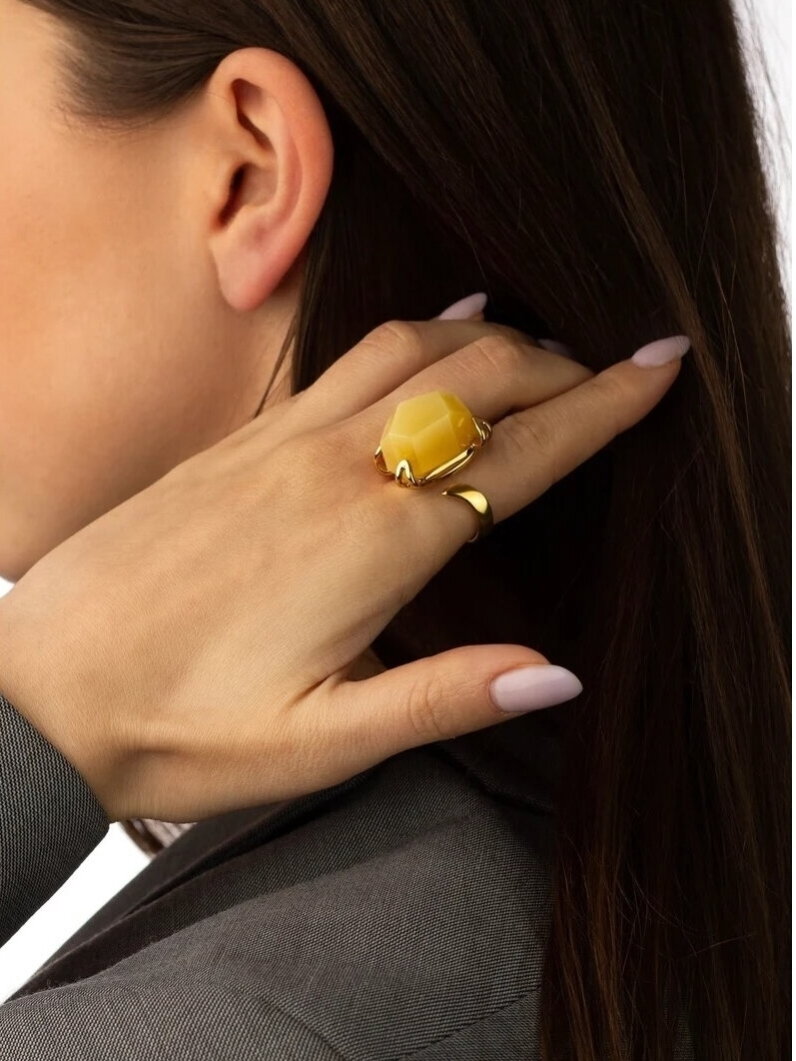
Monumentally Yellow
Compared to other notable amber varieties, such as Dominican or Burmese amber, Baltic amber boasts one of the greatest color diversities – featuring up to 200 shades. The focal point of this ring is a massive, milky-yellow polished Baltic amber stone.The amber is framed in an adjustable ring crafted from 24-karat gold-plated silver.
The jeweler's masterful touch is felt in every detail of this ring – from the leaf-inspired contours to the structure holding the amber and other subtle elements.
THREE IDEAS: For a Brighter Autumn
Cozy details you can turn to when a gray autumn day calls for a touch more color.Large vermilion red wool and silk scarf
Soft brown textured leather tote bag
Camel wide cashmere headbandUncharted Asymmetry
This asymmetrical natural Baltic amber necklace offers a fresh take on a familiar idea.Lightweight (approx. 16.10–18.20 g depending on length) and crafted from polished beads, this necklace pairs effortlessly with classic ensembles as well as more experimental, personal self-expression looks.
The clasp is made of 925 sterling silver.
When wearing, it is worth noting that contact with the skin may naturally cause matte amber to become clearer over time.
Weightless Quartet
These subtle, nature-inspired earrings bring together four distinct shades of amber.Crafted from 24-karat gold-plated silver, these subtly expressive earrings remain remarkably lightweight (weighing less than 3 grams) and comfortable to wear.
Every Friday we share stories on fashion design, culture, and the nature of materials. Subscribe to "Baltas Miškas" to receive inspiration delivered straight to your inbox on time.