Orientalism for the Legs | Wide Lithuanian Designer Trousers
-
2026-11-23
Hello,
Born in Latvia and having emigrated to the United States with her parents, Annie Londonderry became the first woman to cycle around the world in 1895, contributing a small chapter of her own to the history of women's trousers along the way.
Riding a heavy women's bicycle of the era designed for slow riding (it was nearly twice as heavy as a men's bike, weighing around 20 kg), she had already fallen behind schedule after a few weeks on the road. To salvage the journey, she made changes: she swapped her women's bicycle for a men's model, and her floor-length wool skirt for wide trousers.
Driven by such practical reasons, women had long worn trousers in work settings, on farms, and in similar environments, yet until around the 1920s trousers were not part of a refined woman's wardrobe.
The situation changed fundamentally through a confluence of trends, among which the popularity of Orientalism was one of the most significant. Feminist ideas, shifts in women's lifestyles, and other factors mattered, but Orientalism offered both inspiration and aesthetic forms that opened the door for women's trousers in European fashion.
Through Orientalism, Paul Poiret and other designers discovered cultures in the East that felt exotic to Europeans, where women wearing trousers were an everyday sight.
In part, this can be explained by the fact that trousers, both men's and women's, originated in the steppes of Central Asia (the oldest known trousers were found in western China and date back roughly 3,000 years) and spread across Asia.
Thus, as early as 1717 – centuries before Parisian designers discovered women's trousers – Lady Mary Wortley Montagu, in her classic book Turkish Embassy Letters, wrote with a perceptible touch of admiration during her travels in Istanbul about women wearing shalwar trousers tapering toward the ankle, typical of the Ottoman Empire.
Meanwhile, in Europe we inherited the Greek belief, later adopted by the Romans, that unsewn, draped garments such as cloaks and togas were an expression of civilization, while trousers signified barbarism. These ideas later intertwined with Christian tradition (Deuteronomy 22:5: "A woman shall not wear a man's garment, nor shall a man put on a woman's cloak...") and shaped strict notions of masculine and feminine attire.
Orientalism gave designers a vision that allowed them to bypass established norms and introduce trousers in a new way.
Despite these circumstances offering greater creative freedom, the silk shalwar-style trousers Poiret unveiled in 1911 became not only a fashion sensation, but also the target of sharp criticism.
Surprisingly, Poiret was not a feminist and did not support the general idea that women should wear trousers.
"I freed the bust and shackled the legs"
Poiret liked to say this, emphasizing the innovative corsetless silhouettes and wide, ankle-tapering trousers he popularized in fashion.
In his view, only trousers tapering at the bottom (shalwar-style) suited an elegant woman. He designed trousers for "an elegant woman with graceful joints" – trousers meant for quietly enjoying oneself rather than moving with ease.
Wide trousers created around the same time by other designers, such as Margaine-Lacroix, which allowed an unrestricted stride, were in Poiret's eyes an expression of vulgarity.
Poiret's elevated, harem-inspired trousers helped open the path for women's trousers, though the silhouette itself quickly became niche. Even so, the wave of wide trousers in various styles that they set in motion has never stopped rolling to this day. Harem trousers soon gave way to other styles – unsurprisingly often inspired by Asian garments as well – such as wide, straight-cut trousers (inspired by Indian kurta pajamas) or barrel-leg trousers (inspired by Indian jodhpurs), alongside countless others.
In this newsletter, we have selected three pairs of wide trousers by Lithuanian designers: two different barrel-leg styles and one straight silhouette.
All Lithuanian Designer Trousers
Expressive Curve
If the first wave of wide trousers tapering at the hem can be traced to the 1920s, the beginning of the recent trend is considered to be 2023. One reason behind this silhouette's popularity is that it is surprisingly comfortable and flattering across a variety of body types.
In these trousers, the barrel silhouette is essential both visually and when worn.
The curved shape of the black trousers creates a subtle yet expressive aesthetic. Meanwhile, the roomy cut and fabric with a touch of elastane let you enjoy comfort in any situation.THREE IDEAS: For a Weekend at Home
In late autumn, while oaks or chestnuts still rustle their dry yellow leaves in the wind, time spent in a cozy home can be especially sweet.
Here are a few garment ideas to help you enjoy the full spectrum of moments – from the bath to unexpectedly arriving guests.- Green linen waffle-weave robe
- Light blue linen loungewear set with trousers
- Knitted merino wool set with trousers
Lighter Jeans
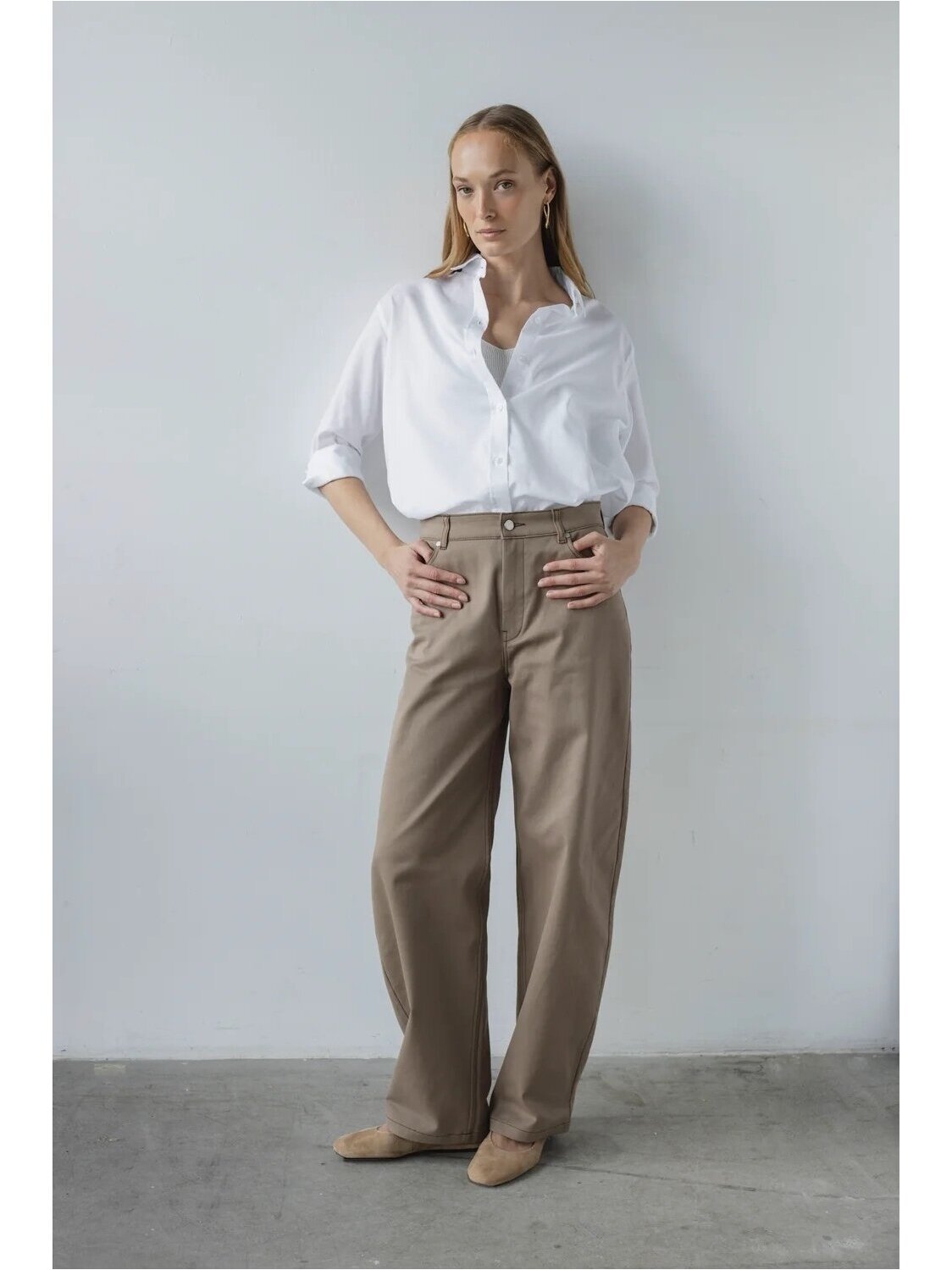
These jeans also feature a barrel shape, yet their silhouette is much softer.
The beige trousers are made from denim, though it is worth noting that the fabric is pleasantly light and slightly stretchy, without the stiffness sometimes associated with jeans.
At the same time, the classic design with a high waist, five pockets, belt loops, and other details preserves the qualities people love about jeans.Bohemian Blue
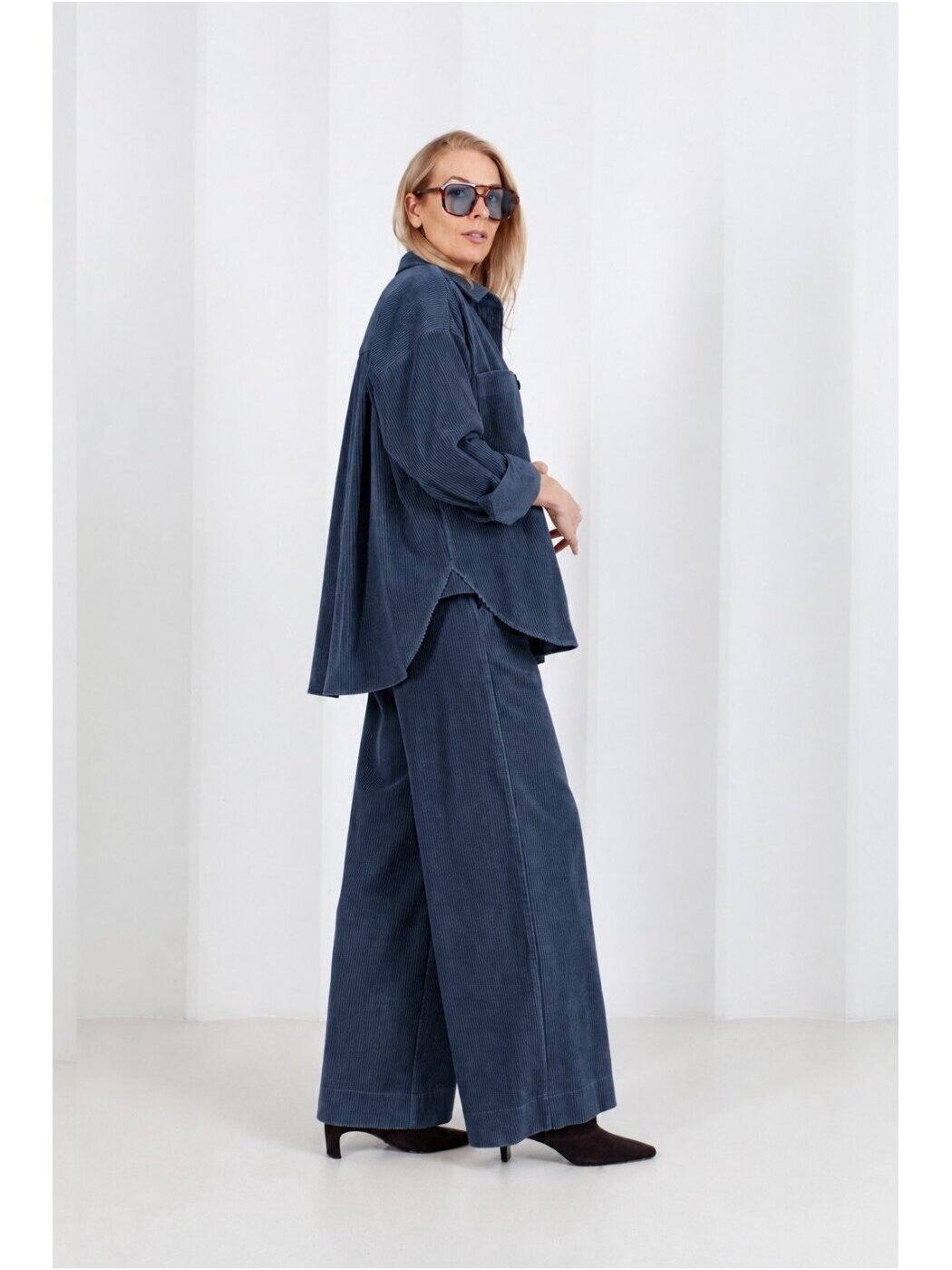
These trousers combine the practicality of cotton velvet – once used primarily for workwear and later favored by Parisian bohemian artists – with an elevated, refined design.
Made from 100% cotton in a rich blue hue, the trousers are wide enough to gain movement as you walk and drape gracefully when seated.
Every Friday we share stories on fashion design, culture, and the nature of materials. Subscribe to "Baltas Miškas" to receive inspiration delivered straight to your inbox on time.