Spun by the Winds for Colette | Fine Knits for Autumn
-

2026-08-28
Knitting traditions span thousands of years, yet lightweight fine-gauge knitwear is a modern innovation.
While extraordinary fine knits were known across various cultures historically, lightweight knit garments began developing in earnest only in the early twentieth century.
Upon their emergence, summer knits became more than simple attire; they evolved into a symbol of a liberated, easeful summer lifestyle.
"Strip off the unnecessary... To feel the wind on bare arms under a thin woolen slip, to shed the heavy armor of the city for a garment you can wring out in sea water—this is the real luxury of summer."In 1932, Colette—one of the early style icons of the French Riviera—captured this vision of effortless knitwear in a collection of biographical essays.
The rise of lightweight knitwear was enabled by innovations in both knitting machinery and yarn spinning technologies.Although consuming a similar length of yarn in meters, fine summer knits can weigh five to six times less than conventional winter knitwear.
To achieve such lightness, specialized yarns and noble fiber blends are employed, predominantly cashmere, merino, and mohair.
Historically, mohair—the fleece of the Angora goat—was among the earliest luxury fibers capable of producing exceptionally fine, lustrous yarns.
In 1556, Ogier Ghiselin de Busbecq, an Austrian ambassador and scholar credited with introducing both Angora goats and tulips to Europe, traveled deep into the Ottoman Empire and penned one of early travel literature's bestsellers, Turcicae Epistolae (Turkish Letters).
Mohair wool was already famed and prized in Europe, so witnessing live Angora goats left a lasting impression on the ambassador. He documented both the goats in detail (crucial at a time when the myth persisted that mohair derived from camels, leading Europeans to refer to it as „Camlet“) and the intricacies of mohair production.
Mohair occupied a paramount status in the Ottoman Empire, serving both as a major economic export and a powerful symbolic textile.
It is said that Sultan Suleiman the Magnificent, under whose reign the Ottoman Empire reached its zenith, dressed exclusively in mohair fabrics. This royal tradition persisted through subsequent rulers, including Kösem Sultan—one of the most powerful women in Ottoman history—who wore cloaks crafted from woven mohair specially treated to yield a silk-like sheen, known as „hareli sof“.
Given these circumstances, it is hardly surprising that the export of Angora goats was strictly controlled by Ottoman authorities.
Only in the 19th century, as the empire waned, did the status quo shift. In 1838, a British merchant secured permission to transport the first shipment of Angora livestock to South Africa.
The consignment comprised twelve bucks and a single doe. Ottoman officials had ensured all twelve bucks were sterilized to safeguard their mohair monopoly. However, through oversight or corruption, the doe was already pregnant prior to shipment.
This storied tale marks the genesis of the South African mohair industry, which today dominates global supply, accounting for over 70% of world mohair production.
Angora goats reached Lithuania even earlier, in the 1760s, through the patronage of the Tyzenhaus family. The herd was secured not directly from the Ottomans, but via small royal stocks in France and Spain descended from diplomatic gifts. However, as in many other European regions, attempts to cultivate Angora goats faltered due to their extreme sensitivity to climate and feed.
While mohair grew into one of the most coveted fibers for fine summer knits, it remains far from the only luxury yarn in modern tailoring.
In this edition, we have selected three fine-knit sweaters in distinct luxury yarn blends, ideally suited for early autumn.
All Fine Knits by Lithuanian Designers
Silken Core
Beside its many virtues, pure mohair presents specific structural challenges.Although mohair is a strong natural fiber, it lacks natural elasticity. Consequently, a garment knitted from 100% mohair tends to stretch out of shape under its own weight over time. For this reason, 100% mohair was historically reserved for woven textiles, while knitwear relied on mohair blended with wool, and later, technical fibers.
Blends of mohair and silk were known as early as the 16th century. At the time, however, they were known as „grogram“—a term often synonymous with coarse, utilitarian fabrics.
The modern luxury combination of fine mohair spun around a silk core became achievable only in the late 20th century, following technical advancements in precision spinning that allowed ultra-fine mohair fibers to wrap around a continuous filament of Mulberry silk.
This combination yields an exceptional yarn that harmonizes the finest qualities of both natural fibers.
Sheer Comfort
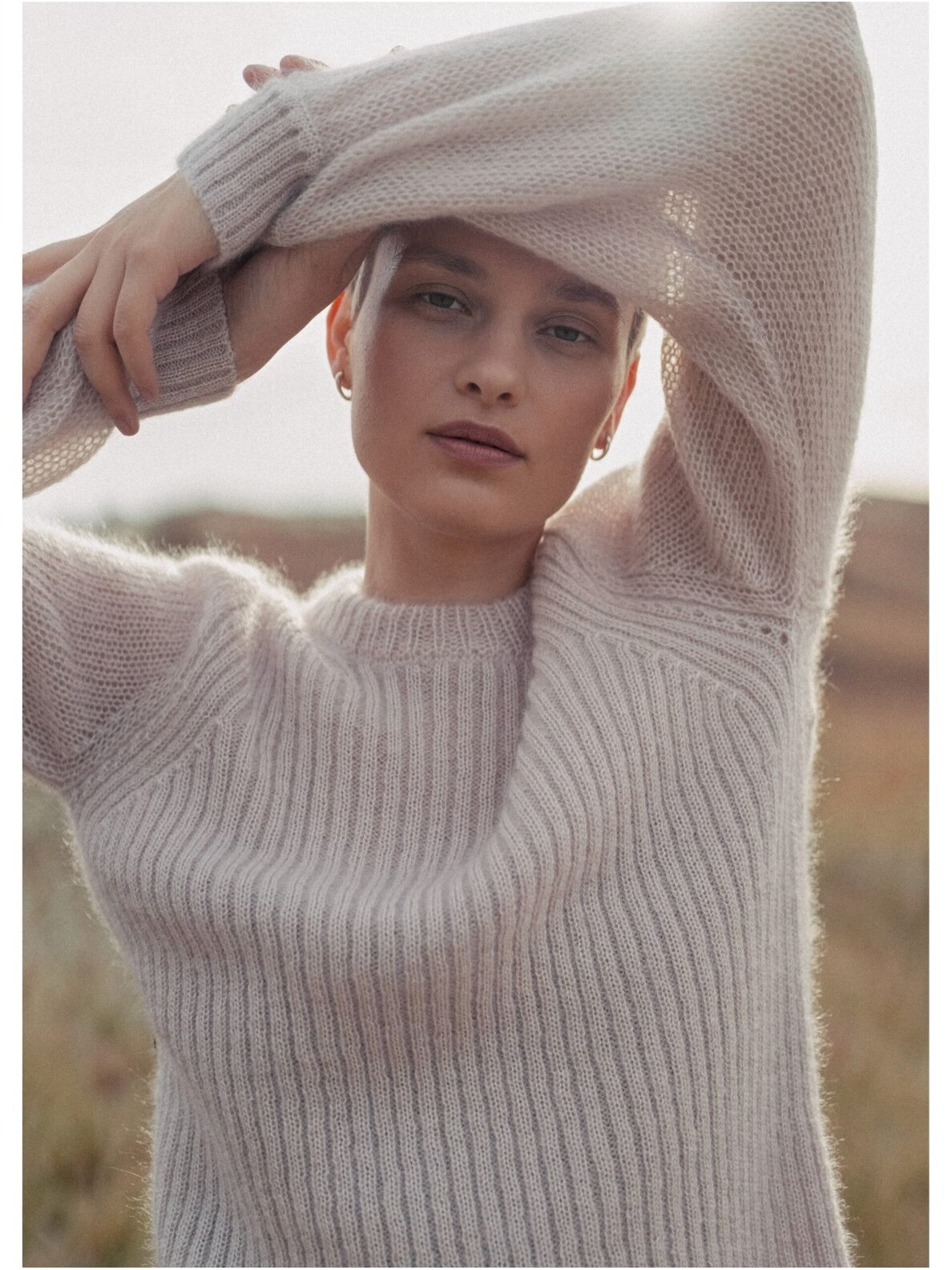
This knit sweater utilizes thoughtful textile techniques to maximize the properties of an exquisite Italian yarn: 30% natural Mulberry silk and 70% RMS-certified Super Kid Mohair.The body is crafted in a fine ribbed knit, imparting natural stretch and gentle warmth.
In contrast, the sleeves feature a delicate, semi-sheer openwork stitch that adds airy lightness and visual subtlety.
Together, these elements create an ideal piece for late summer weather—lightweight, tactile, and comfortably warm.
THREE IDEAS: Back in Stock
When we introduced the restock notification feature a few years ago, we did not anticipate how popular it would become.It is always rewarding to share news that a long-awaited piece has returned, but even more meaningful is the sense of direct dialogue it creates with you.
We invite you to mark items on your wishlist, and we will notify you the moment they return.
Here are three highlighted pieces selected from our latest restocks.
Versatile Essential
Crafted from 10% cashmere and 90% merino wool, this lightweight knit anchors the versatile mid-layer wardrobe.Designed to transition effortlessly, it can serve as a refined alternative to a collared shirt, stand alone as a fine-gauge knit, or layer under seasonal outerwear.
Elevated Leisure
Featuring a subtle, body-skimming fine knit and a refined deep V-neck, this piece balances formal office elegance with the relaxed comfort of loungewear.Spun from 70% cashmere and 30% merino wool.