Without Clothes in Charleston | Summer Cardigans by Lithuanian Designers
-

„Bring no clothes“, wrote Virginia Woolf, inviting friends to visit her family's summer home, Charleston Farmhouse.
This phrase served as a code expressing the attitude toward dress held by the like-minded circle of intellectuals who gathered here—one that disregarded rigid rules and formal norms. A key element of this style was the long, comfortable cardigan: unrestricted, effortless, and allowing full focus to remain on conversation, creativity, and ideas.
The Bloomsbury Group, which exerted a profound influence on literature, art, aesthetic development, and intellectual history, was an informal collective bringing together writers, artists, economists, and thinkers of the era.
Among the group's most prominent figures were Virginia Woolf, her sister, the painter Vanessa Bell, writers T. S. Eliot and E. M. Forster, economist John Maynard Keynes, and many other distinguished cultural figures of the early 20th century.
A silk dress paired with a large, often visibly mended cardigan—this combination could be considered the unofficial uniform of the Bloomsbury Group women, particularly Virginia Woolf. This synthesis of utility and elegance embodied the group's philosophy (heavily influenced by the now-often-overlooked philosopher G. E. Moore), emphasizing personal freedom, love, creativity, and the pursuit of knowledge.
„Slovenly Elegance“—that was how Woolf herself described this aesthetic.
The long, unrestrictive cardigans worn at Charleston Farmhouse were adopted by London intellectuals from the residents of the surrounding Sussex countryside.
The Sussex region of England had long been celebrated for its knitting heritage. It was home to Southdown sheep, whose wool was regarded as among the finest in the United Kingdom, second in quality only to Spanish Merino.
Owing to the chalky soil and the vegetation it sustained, Southdown wool possessed not only exceptional softness, but also remarkable elasticity. This resilience allowed for the knitting of long cardigans that retained their shape without sagging under their own weight during wear.
Densely patterned cardigans were knitted primarily for utility—featuring a relaxed silhouette and spacious pockets with reinforced bases designed to securely carry everyday farm tools.
Thus, Virginia Woolf and her fellow Bloomsbury Group members naturally integrated into the rhythm of local life, embracing these long, comfortable cardigans ideal for leisure or hours spent working in art studios.
Indirectly, these Sussex sheep also contributed to the broader adoption of knitwear in Lithuania.
Until the early 20th century, sweater knitting was virtually nonexistent in Lithuania, partly because the coarse wool of local sheep was ill-suited for garments.
During the interwar period, efforts were made to breed a new sheep variety yielding softer wool suitable for clothing. Crossing local sheep with English breeds closely related to the Southdown gave rise to the Lithuanian Blackhead sheep. This resilient, elastic native wool helped spark a flourishing home-knitting culture across Lithuania.
The transformation of the cardigan—from a utilitarian farm garment to a rebellious symbol favored by artists and ultimately a fashion staple—unfolded over several decades. Today, this versatile piece can be found across a vast array of styles and forms.
In this newsletter, we have curated three long-line cardigans: a light long wrap cardigan, a plush cable-knit model, and an elegant slightly elongated style.
All Lithuanian Designer Cardigans for Women
Wrapped Comfort
Crafted from soft wool, this hooded cardigan is lightweight and drapes beautifully against the body while providing warmth and comfort. A charming detail—extended fold-over cuffs—gives the design a distinct accent while offering extra warmth on cooler summer days.Certified sustainable fabric composition—15% cashmere and 85% merino wool—ensures exceptional softness. Non-itchy and gentle, it feels wonderfully pleasant even when worn directly against the skin.
THREE IDEAS: Last Pieces
A few weeks ago, we shared a similar feature and received such positive feedback that we decided to revisit the theme of last remaining pieces. (Perhaps the "Last Pieces" selection should become a regular feature?)Small-batch collections from independent designers are inherently limited in quantity, though not all items sell out immediately. This section features pieces that were either produced in extremely small runs or proved exceptionally popular.
- Mohair and silk wrap cardigan
- Pale yellow safari-style linen shirt/jacket
- Textured 100% woven palm leaf bucket hat
Knee-Length Cable Knit
This cable-knit cardigan stands out for its versatility, transitioning effortlessly between casual everyday looks and more refined occasions.A thoughtfully selected yarn blend (30% alpaca wool, 30% merino wool, 10% lamb's wool, and 30% polyacrylic) lends the knit a subtle luster, refined drape, and lasting durability.
Plush texture, a relaxed silhouette, easy closure, and subtle puff sleeves offer exceptional comfort. It is a cardigan designed for both cozy leisure and polished everyday style.
Alpaca Elegance
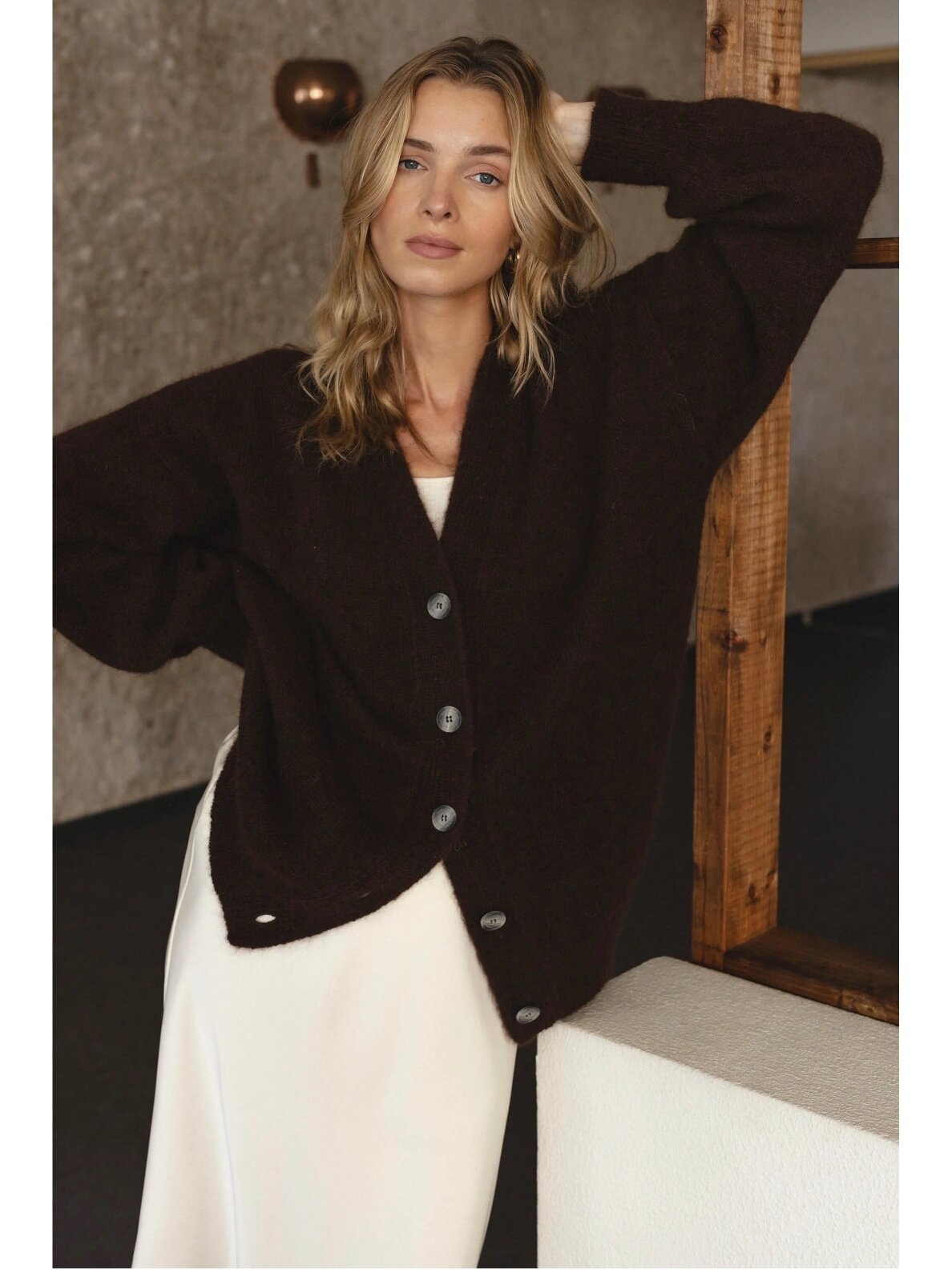
Crafted from alpaca wool, this cardigan features a classic, slightly elongated silhouette that fulfills every expectation of premium knitwear. Exceptionally soft and comfortable yet sophisticated, it pairs easily with relaxed or dressier outfits alike.Available in three rich colors. Pictured here in dark brown.