Woolen Saltaire | Lithuanian Designer Alpaca Wool Clothing
-
2026-10-30
The town of Saltaire was created as a perfect place to live.
Bright houses equipped with the most modern 19th-century engineering, free schools, hospitals, parks, clean air (factory chimney gases were specially treated), and other benefits were designed for more than five thousand residents.
All of this was made possible by alpaca wool, which was previously considered worthless.
At the beginning of the 19th century, European textile manufacturers viewed alpaca wool as a low-grade raw material. Although its advantages had already been noticed, contemporary industrial spinning machines could not yet process it properly.
The breakthrough came in 1836, when textile manufacturer Titus Salt, immersed in the constant pursuit of innovation, discovered a large quantity of alpaca wool in his warehouse and decided to find a way to process it.
Utilizing a whole series of adaptations and innovations, he discovered a way to mass-produce strong alpaca yarns and fabrics. One of his most significant fabric creations was a blend of alpaca wool and cotton.
Woven alpaca fabric, mostly of the "Alpaca Orleans" type, became one of the most popular fabrics of the second half of the 19th century.
This strong, slightly glossy alpaca fabric became very popular for sewing skirts, jackets, light coats, and other garments. At the peak of its popularity, United Kingdom textile manufacturers consumed about 95% of the world's alpaca wool production.
Alpaca wool allowed Titus Salt to amass a vast fortune, which, tired of the polluted air and overall poor living conditions of the city of Bradford where he lived, provided the opportunity to undertake the construction of the town of Saltaire.
Since 1871, Saltaire (designated a UNESCO World Heritage site in 2001) became the center of alpaca wool and other textile production, embodying nearly a century of history of alpaca wool as an inexpensive and widely used fiber.
Alpaca wool fabrics were handsome, resembling silk in their luster, possessed excellent properties, and most importantly were inexpensive—costing more than half as much as cashmere or merino wool.
In the 1960s, the era of cheap alpaca wool came to an end.
Producers in Peru (which produces about 80% of the world's alpaca wool) realized that alpaca could no longer compete with synthetic fabrics and made a decision whose consequences we feel to this day—to begin sorting alpaca wool.
Until then, all alpaca wool was processed together, without separating the significantly higher quality inner layer from the coarser outer one.
Three structural types of alpaca wool were distinguished, determined by fiber thickness in microns.
Royal Alpaca: <19μm about 1% of total wool volume
Baby Alpaca: 19–22μm about 12-15%
Superfine: 25.5μm about 25-30%
This grading system paved the way for alpaca to establish itself in the premium fashion segment, and related textile innovations finally allowed alpaca yarns to be adapted for industrial knitting.Although alpaca was already used for knitwear in the Inca civilization, knitted alpaca essentially disappeared during the era of mechanized textiles, and alpaca wool was used almost exclusively for woven fabrics.
Thanks to all these changes, alpaca wool gradually became a niche fiber (even regardless of its grading, nearly 4 times less alpaca wool is produced than, for example, cashmere), highly valued by designers and used to create exceptional garments.
In this newsletter, we have selected three pieces—a long dress, a lounge set, and a sweater—that showcase the different possibilities of alpaca wool.
All Lithuanian Designer Alpaca Wool Products
Andean Softness
At first glance similar to other high-quality wools, alpaca wool (more precisely, hair) possesses unique properties.Alpaca fiber is hollow, meaning it provides just as much warmth as other wools while weighing less.
The fiber structure has no scales, and the fiber itself is significantly longer than, for example, cashmere, making alpaca wool much less prone to pilling and felting.
Highly resistant to moisture
Resistant to odor accumulation
Contains no lanolin
Alpaca wool has low elasticity, which is precisely why it falls and drapes so beautifully.
Draping Wool
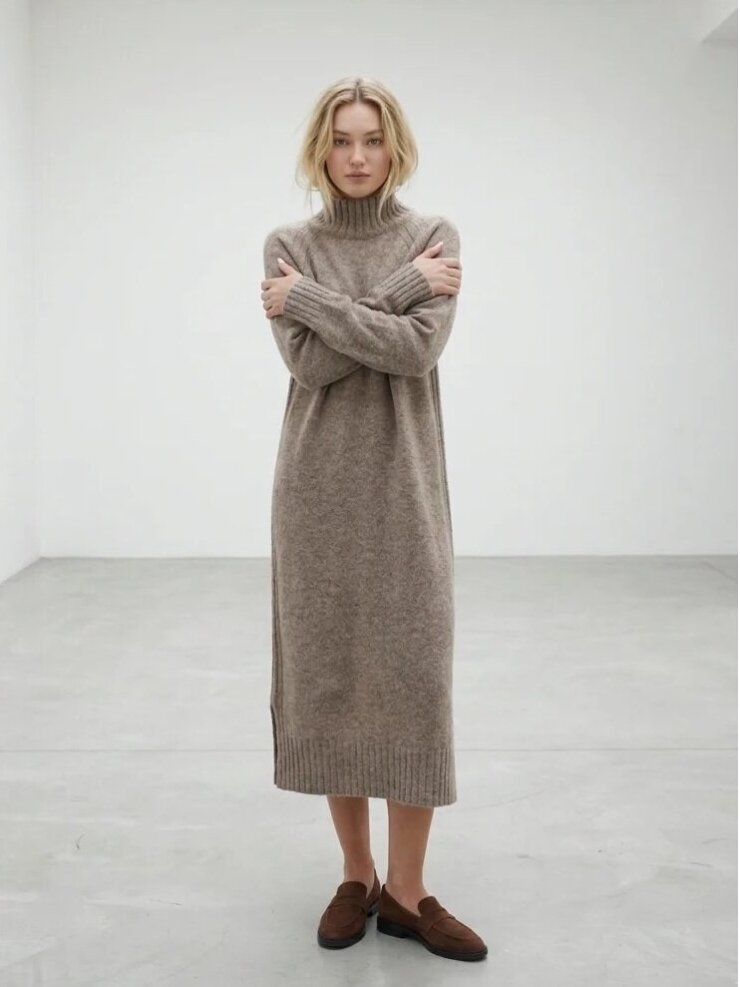
This long, high-necked dress conceals a whole range of thoughtful features within an unpretentious form.Crafted from Italian, exceptionally soft "Baby Alpaca" yarns (with a small portion of merino wool and nylon to give the long dress the necessary durability), it is knitted using a "fully-fashioned" method, ensuring that the dress's shape and size remain unchanged.
The dress features a straight, movement-unrestricting, not overly fitted silhouette with side slits.
One size available, in cocoa (pictured), gray, and dark gray.
Cocoa DressTHREE IDEAS: Blue and Brown Autumn
Various shades of blue continue to grow increasingly popular in autumn and winter fashion. Here we share a blue and brown combination idea, complemented by an exceptionally lightweight suede handbag.- Lightweight suede handbag with amethyst lining
- Blue unisex oversized shirt
- High-waisted brown trousers
Fluffy Combination
In this surprisingly lightweight, 100% alpaca wool lounge set, leisure fashion aesthetics are expressed in a refined, minimalist way.The cozy set is as comfortable as pajamas, yet visually refined enough to suit the office.
BM observations: alpaca wool differs structurally from other wools, making garments knitted from it significantly more breathable. This is especially relevant when frequently moving from a cool outdoors into warm indoor spaces.
Paula Lounge SetEffortless Classic
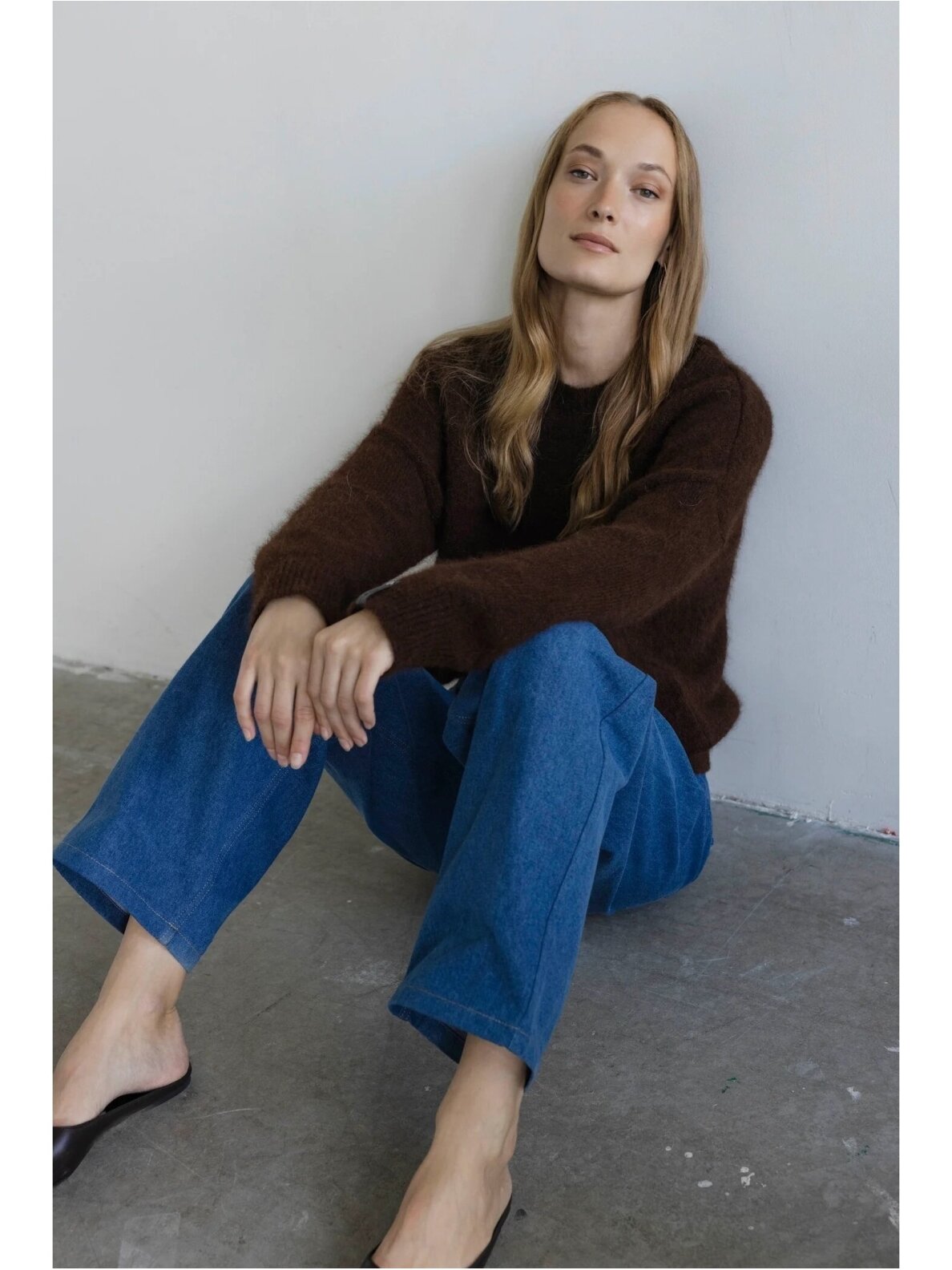
This rich brown sweater does not break norms, but rather expresses traditional ideas with subtle confidence.A classic oversize silhouette sweater with slightly elongated sleeves, knitted from an exquisite blend: 75% alpaca wool and 25% polyamide. It offers effortless stylistic freedom.
Chloe Sweater
If you would like to receive our full recommendation letter featuring updates on the latest designer pieces, subscribe to our weekly newsletter sent every Friday.